Webinar: Teaching SaaS Systems to Listen with Fabric
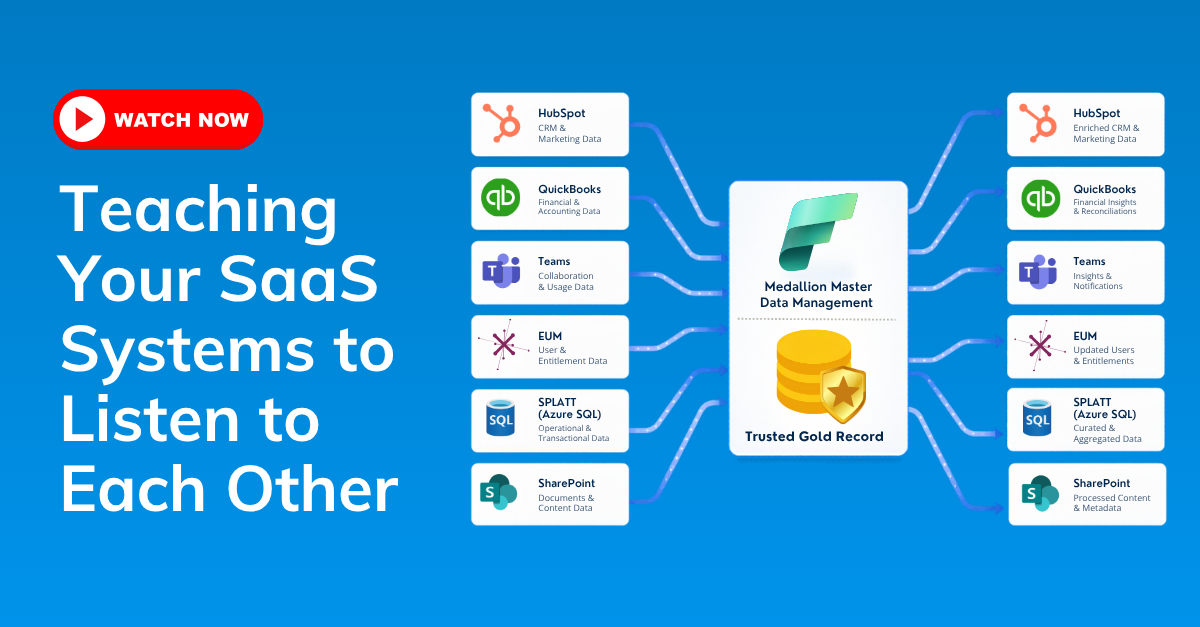
Teaching Your SaaS Systems to Listen to Each Other with Microsoft Fabric
Pushing master data back into the source systems
This is Session 2 of Envision IT's Microsoft Fabric Summer Webinar Series. AI is only as good as the data behind it, and this series is designed to fix that, one architectural layer at a time. See the full 6-part series lineup and the thread that ties it all together.
Who this session is for:
This session is for IT leaders, data architects, Microsoft Fabric admins, Microsoft 365 admins, and integration teams responsible for keeping business systems aligned.
If your organization has started bringing SaaS and custom system data into Microsoft Fabric, the next question is:
How do you get trusted data back into the systems people use every day?
Join this session if:
- Your CRM, HRIS, finance, directory, and collaboration tools contain overlapping data
- Teams are still correcting the same records in multiple systems
- Reports look cleaner, but source systems still fall out of sync
- You want your operational systems to benefit from the trusted golden record you’re building in Fabric
- Your AI, Power BI, or Copilot roadmap depends on cleaner, more reliable data
What this session is about:
Putting data into Microsoft Fabric is a major step, but it is only half the story.
Your sales team still works in the CRM. Finance still uses its own platform. HR still manages people data in the HRIS. If trusted data lives only in Fabric, the same inconsistencies keep appearing where people actually work.
In this session, we’ll look at the write-back side of a Medallion Master Data Management architecture. You’ll learn how trusted data from the gold layer can flow back into SaaS and custom systems, when it is safe to do so, and why write-back is what turns Fabric from a reporting foundation into an operational data foundation.
What you will learn from this session:
In 45 minutes, you’ll learn how to design a safe, scalable write-back pattern for master data in Microsoft Fabric.
You’ll walk away knowing how to:
- Understand when your gold layer is ready for write-back
Learn why trusted data needs to be validated before it becomes authoritative enough to update source systems.
- Identify which systems should receive which master data
Decide where cleaned customer, employee, vendor, project, or operational data should flow back, and where it should not.
- Design a write-back pattern from Fabric to SaaS and custom systems
See how the same integration thinking from Session 1 applies in reverse, moving trusted data from Fabric back into the tools your teams use every day.
- Reduce duplicate updates across systems
Learn how a governed write-back approach can reduce manual fixes, repeated data entry, and conflicting updates.
- Support better reporting, AI, and day-to-day operations
See why the payoff is more than cleaner dashboards. It is cleaner systems, better decisions, and a stronger foundation for Power BI, Copilot, and AI Search.